
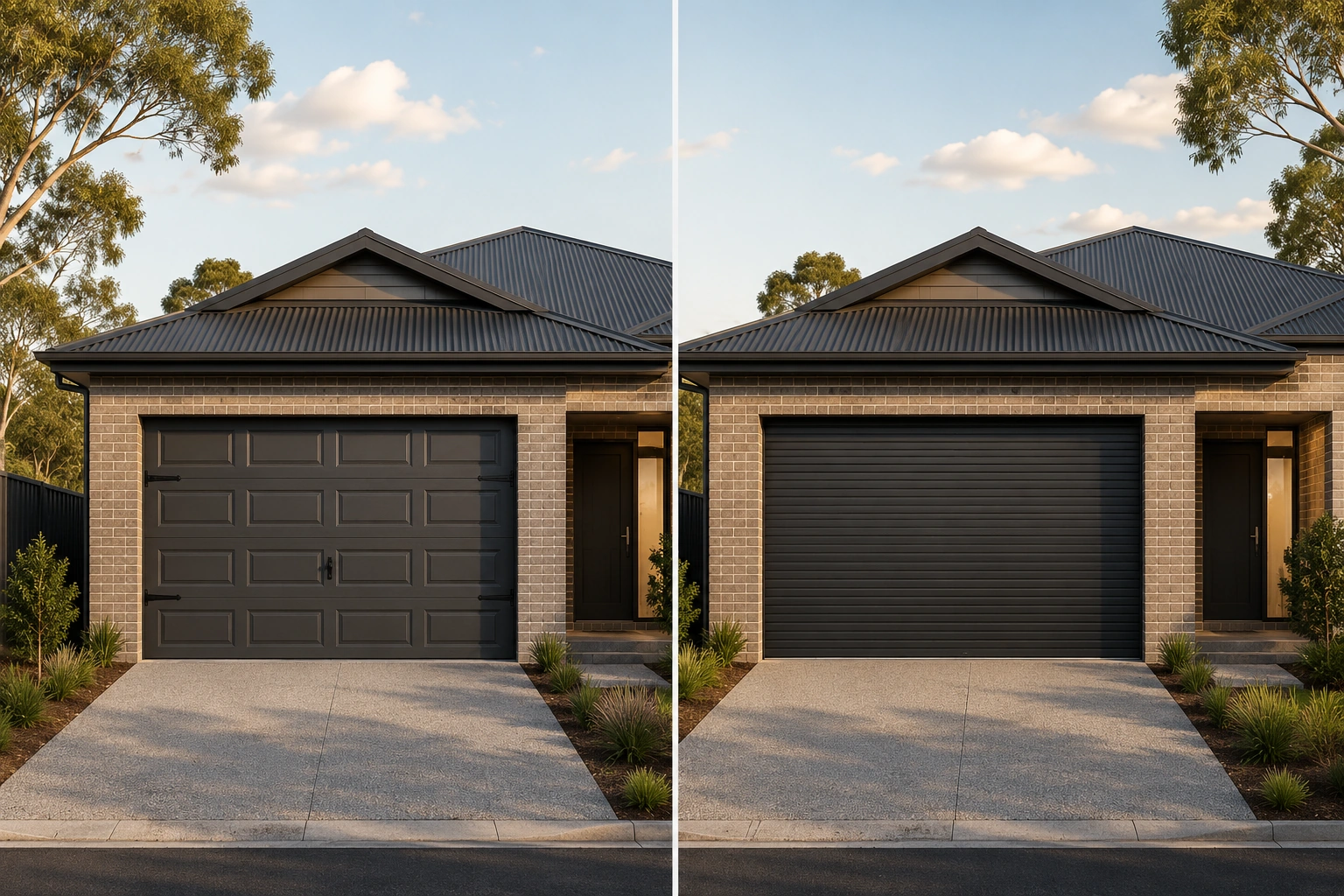
Roller doors generally offer better security than traditional garage doors due to their compact design, stronger track systems, and fewer exposed weak points.
But design alone doesn’t determine security. A reinforced traditional door with quality locks can outperform a cheap roller door with weak installation. That’s why the door type is less important than how it’s built, the locking system it uses, and how well it’s fitted to the garage opening.
This guide breaks down build quality, locking systems, and common vulnerabilities to show how roller doors vs garage doors compare on security. By the end, you’ll understand how each option performs and which one better suits your home.
Let’s get into it.
Roller Doors vs Traditional Garage Doors: Core Security Differences

Security comes down to two things: how much force a door can take, and how easy it is to get past the lock. Below, we cover both.
Build Strength and Resistance to Physical Attack
Roller doors use continuous horizontal slats that interlock across the whole door. That unbroken structure means there are no seams, hinges, or joints for an intruder to target. Sectional doors don’t have that advantage. They’re made up of individual steel panels connected by hinges, and those hinge points flex under impact pressure. That’s exactly where a forced entry attempt will focus.
The thicker the slat profile on a roller door, the more impact the whole door absorbs without bending. So it holds up far better under repeated stress than a hinged panel system ever will.
Locking Systems and Access Vulnerabilities
Most traditional doors use a manual lock with an exposed handle or key cylinder, which gives intruders a clear target. In fact, we’ve handled jobs in Brisbane where traditional garage doors were opened in minutes, simply because the exposed lock cylinder was easy to bypass.
By contrast, roller doors lock automatically when closed, with no external handle or visible key cylinder to exploit. This reduces access points and lowers the risk of the door being left unsecured due to human error.
Real-World Break-In Scenarios: Forced Entry Methods Compared

About 9% of burglars enter through the garage, and most of them don’t force their way in. They look for the path of least resistance. With traditional sectional doors, that’s often the bottom rail or panel joints, which are more vulnerable under lifting pressure.
There’s also a method called “fishing,” where a thin tool is pushed through the top gap to manually release the opener. It’s low-tech, takes less than a minute, and still works on many older garage doors across Australian homes.
Roller doors remove that weak point entirely. The continuous slat design sits flush within the tracks and leaves no top gap to exploit. And without an external handle or keyhole, there are fewer access points for intruders to target.
For homeowners wanting stronger overall perimeter security, security screen doors with stainless steel mesh add another barrier against forced entry. Combined with a secure garage door, they make opportunistic break-ins far more difficult.
How Security Changes as Garage Doors Age
A garage door that felt solid and secure when it was installed can become a weak point a few years later without any obvious damage. The change usually happens slowly, as components wear down and maintenance gets delayed.
With traditional sectional doors, the first signs usually show up as noise. Hinges start creaking, panels shift slightly out of alignment, and the bottom seal stops sitting flush against the floor. Once that seal starts lifting, even a 15mm gap is enough for the “fishing” method to work. We’ve seen it firsthand in Brisbane, especially on older doors that hadn’t been resealed for years.
Roller doors wear differently. The rollers and tracks carry the load instead of hinges, so there are fewer failure points overall. But worn rollers can cause the door to sit unevenly in the tracks, which affects how securely it locks.
If a roller door feels loose or rattles on the way down, it’s worth getting checked. That movement can mean the locking system is no longer engaging properly.
Pro Tip: Test your garage door balance and locking movement at least once every few months. If the door starts rattling, sticking, or sitting unevenly in the tracks, book a service before the problem affects security.
Built for Real Homes: Weather, Stress, and Structural Reliability

Australia experiences a wide range of harsh weather conditions. Summers regularly push past 40 degrees, and storm season runs from November through April. In fact, the 2025– 26 season produced 11 tropical cyclones, above the historical average.
These storms bring strong wind loads that put garage doors under repeated pressure. High wind pressure, for instance, forces the door against the frame unevenly. Over time, that repeated stress can distort the tracks and reduce how well the door seals at the opening. Once the tracks shift, the door no longer sits true in the frame, which affects both weather sealing and overall alignment under load.
Extreme heat adds further strain. In high-temperature regions, poorly constructed doors can warp along the frame and bottom rail. That distortion reduces sealing performance and compromises long-term structural integrity.
The door you choose needs to handle both stresses. A well-built roller door expands more evenly and holds alignment through seasonal change. And if you’re in bushfire-prone areas, a properly rated door also improves resistance to heat exposure and ember intrusion at the garage opening.
Final Verdict: Which Garage Door Offers Better Security?
For most Australian homes, roller doors are the stronger security option. They offer fewer weak points, automatic locking, and better structural performance under the kinds of conditions Australian homes face. But the best door for your home depends on a few factors specific to your situation, so here’s a simple way to break it down:
- Go with a Roller Door If: You want automatic locking, minimal gaps, and long-term security with low maintenance.
- Stick with a Sectional Door If: You’re in a lower-risk area, have a tighter budget, and commit to regular servicing and lock upgrades.
Not sure which one suits your home? The Not Vanilla offers a free measure and quote, so you’re choosing based on your actual setup and not a guess. Get in touch with our team today.